The element
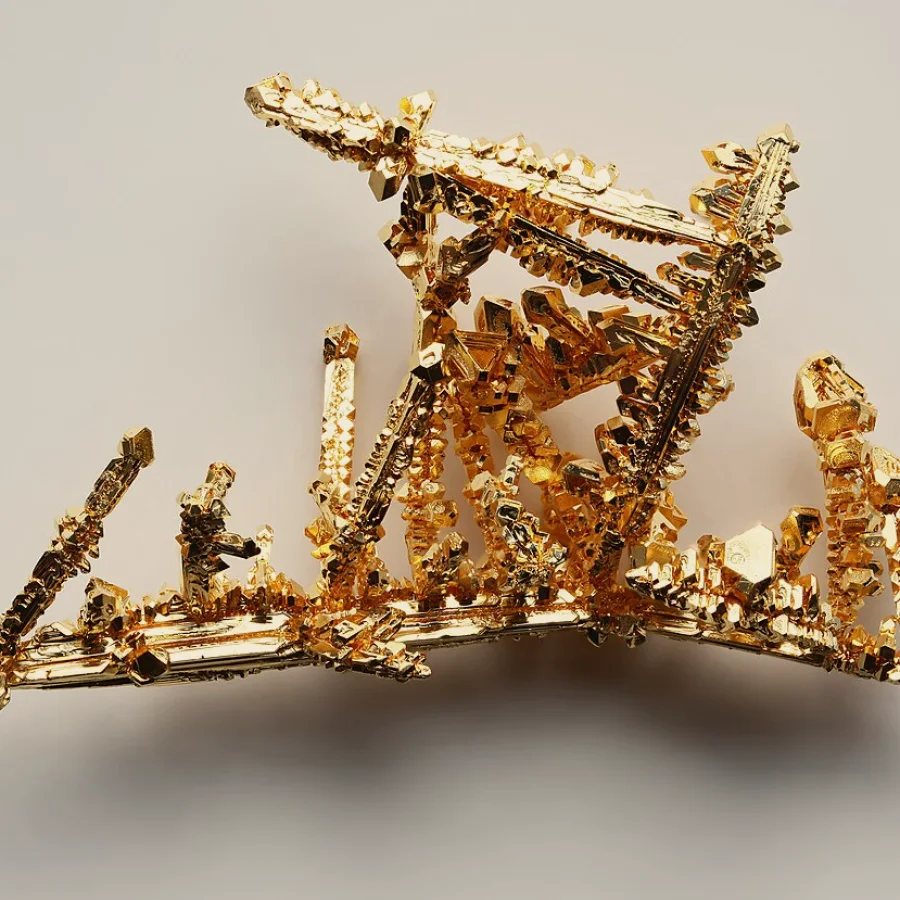
Gold is element 79. Its symbol, Au, comes from the Latin aurum. It does not tarnish or corrode in air or water, and it is the most malleable of all metals: a single gram can be beaten into a sheet about a square metre in area.
In colloidal form
A colloid is a liquid carrying particles between roughly 1 and 1,000 nanometres across. A nanometre is a billionth of a metre. Particles that small do not sink, yet they are large enough to scatter light, which is why a beam shone through a colloid shows up as a visible line.
Gold behaves unexpectedly at this scale. Very fine gold particles in liquid look ruby red, not yellow, because particles that small absorb and scatter light differently from the solid metal. The same effect colours the fourth-century Roman Lycurgus Cup and the red of much medieval stained glass. Michael Faraday prepared ruby gold colloids in 1857, and some of his samples are still kept at the Royal Institution in London.
Details
Placeholder: add the volume, concentration, ingredients, how it is made and directions from your own label.
Specifications
- Composition24-carat gold
- Purity99.99% pure source metals
- Concentration30–50 ppm
- Particle sizeAbout 5–30 nm
- StabiliserCitrate
- Made byInfrared fibre-laser ablation in distilled water
- AppearanceLight cherry tint, almost clear; may vary from batch to batch
- CheckedEvery bottle is checked with a laser beam before dispatch
- Bottle500 ml, reusable laboratory-grade glass reagent bottle
- StorageKeep away from direct light and heat. No refrigeration needed.
Composition and specifications only. XSKOOL makes no health or medical claims for this product.